Emergency departments (EDs) are an essential link in the healthcare system; however, ED visits for non-urgent conditions strain limited healthcare resources, incur unnecessary healthcare costs and contribute to suboptimal care coordination. Fortunately, with the help of the ACG System, users can identify and address potentially avoidable ED visits, ultimately streamlining access to health services for patients while revealing potential healthcare savings.
How it works
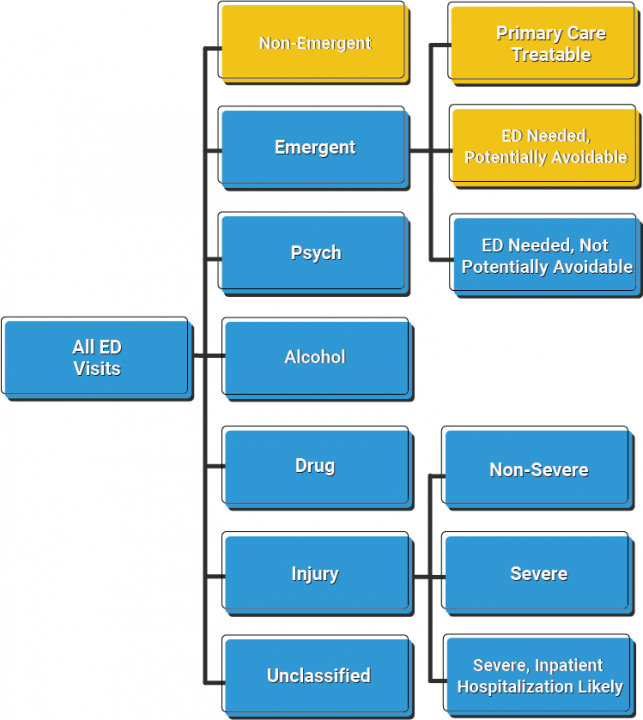
The ACG System uses a custom algorithm developed by researchers at the Johns Hopkins Center for Population Health IT (Cphit). In collaboration with a team of experienced clinicians and health services researchers, the CPHIT team reviewed and assigned 70,000 individual diagnostic codes that occur in billing and clinical records The ACG System’s mappings are updated quarterly as new codes are released, generating a comprehensive algorithm that classifies 99% of ED visits in a typical population.
How customers use it
The ACG System’s proprietary ED classification algorithm is used by customers the world over to understand patterns of care, identify patients who may benefit from additional services, and quantify and monitor cost savings. Typical applications include:
- Understanding ED utilization patterns within a population
- Identifying patients with frequent, avoidable ED use
- Monitoring ED visit rates by PCP group assignment, using the ACG System’s internet case-mix adjustment values
- Tracking and trending interventions to reduce ED use
- Quantifying expected savings from diversion to urgent care or PCP offices
Findings within Johns Hopkins
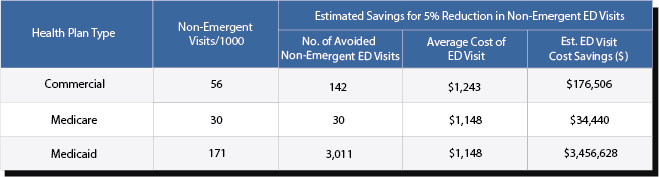
This new classification system was tested on real-world data from our Johns Hopkins Medicare, Medicaid and commercial health plans. Results indicated that just over 33% of ED visits occurred for diagnoses that are non-urgent. In addition, 28% of ED visits could have been prevented through primary care. Digging even deeper into the data, researchers found that nearly 20% of patients with a non-emergent ED visit had not seen a primary care physician in the past year, revealing an unmet healthcare need. All of this information can help providers find ways to streamline access to healthcare services. Beyond improving patient access to healthcare services, reducing the number of non-emergent ED visits can also lead to major cost savings—for JHHC in this case, an estimated $3.8 million.*
How it can help you
Through the power of the ACG System, users can more accurately understand causes, trends, and variation within Emergency Department visits. With 99% of visits classified and up-to-date mappings on current codesets, users have the granularity and clinical insights they need to take action. Ultimately, the ACG System can help highlight specific, measurable instances of healthcare overutilization, giving providers, health plans and other organizations the information they need to reduce costly ED utilization and thereby reduce overall healthcare costs.
*Johns Hopkins HealthCare Internal Analysis, 2017.
Interested in Emergency Department Classification? You may also want to check out this.