Hospital
-
Alive and at home: Five-year outcomes in older adults following emergency general surgery
Abstract BACKGROUND While the short-term risks of emergency general surgery (EGS) admission among older adults have been studied, little is known about long-term functional outcomes in this population. Our objective…
-
Impact of preoperative echocardiography on surgical delays and outcomes among adults with hip fracture
Aims Echocardiography is commonly used in hip fracture patients to evaluate perioperative cardiac risk. However, echocardiography that delays surgical repair may be harmful. The objective of this study was to…
-
Using Health Plan Authorization Data to Predict Hospitalizations and Readmissions in a Combined Commercial and Medicaid Population
Abstract Health plans develop predictive models to predict key clinical events (eg, admissions, readmissions, emergency department visits). The authors developed predictive models of admissions and readmissions for a quality improvement…
-
Identification of Prenatal Opioid Exposure Within Health Administrative Databases
Abstract BACKGROUND: Health administrative data offer a vital source of data on maternal prenatal opioid exposure (POE). The impact of different methods to estimate POE, especially combining maternal and newborn records,…
-
Association between neuraxial anaesthesia or general anaesthesia for lower limb revascularisation surgery in adults and clinical outcomes: population based comparative effectiveness study
Abstract Objective To examine the associations between neuraxial anaesthesia or general anaesthesia and clinical outcomes, length of hospital stay, and readmission in adults undergoing lower limb revascularisation surgery. Main Outcome…
-
Declining Use of Red Blood Cell Transfusions for Gastrointestinal Cancer Surgery: A Population-Based Analysis
Abstract Background Gastrointestinal cancer surgery patients often develop perioperative anemia commonly treated with red blood cell (RBC) transfusions. Given the potential associated risks, evidence published over the past 10 years supports…
-
Effect of frailty on postoperative readmissions and cost of care for ovarian cancer
Abstract Objectives Frailty, defined as loss of reserve and vulnerability to changes in health, affects many ovarian cancer patients who are planned to undergo surgery. The effect of frailty on…
-
Peri‐complication diagnosis of hepatitis C infection: Risk factors and trends over time
Abstract Background & Aims Hepatitis C virus (HCV) is a common and treatable cause of cirrhosis and its complications, yet many chronically infected individuals remain undiagnosed until a late stage.…
-
Pain and haemorrhage are the most common reasons for emergency department use and hospital admission in adults following ambulatory surgery: results of a population-based cohort study
Abstract Background Advances in healthcare delivery have allowed for the increase in the number of ambulatory surgery procedures performed in Canada. Despite these advances, patients return to hospital following discharge.…
-
Impact of frailty on inpatient outcomes in thyroid cancer surgery: 10-year results from the U.S. national inpatient sample
Abstract Background Frailty is linked to perioperative morbidity and mortality. We evaluated the impact of preoperative frailty on inpatient outcomes of patients undergoing surgery for thyroid malignancy. Methods This population-based,…
-

Patients at High Risk from COVID-19
During the current healthcare crisis, health systems, health plans and governments urgently need to identify their most vulnerable patient populations.
-
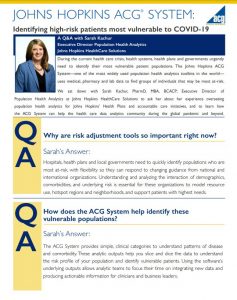
Identifying High Risk COVID-19 Patients Q&A
During the current healthcare crisis, health systems, health plans and governments urgently need to identify their most vulnerable patient populations. The Johns Hopkins ACG System uses medical, pharmacy and lab…